
The Shift from Products to Platforms
For decades, the goal of a food company was simple: bake a good product and put it on as many shelves as possible. But in today’s market, the most successful players have moved toward a platform-based strategy.
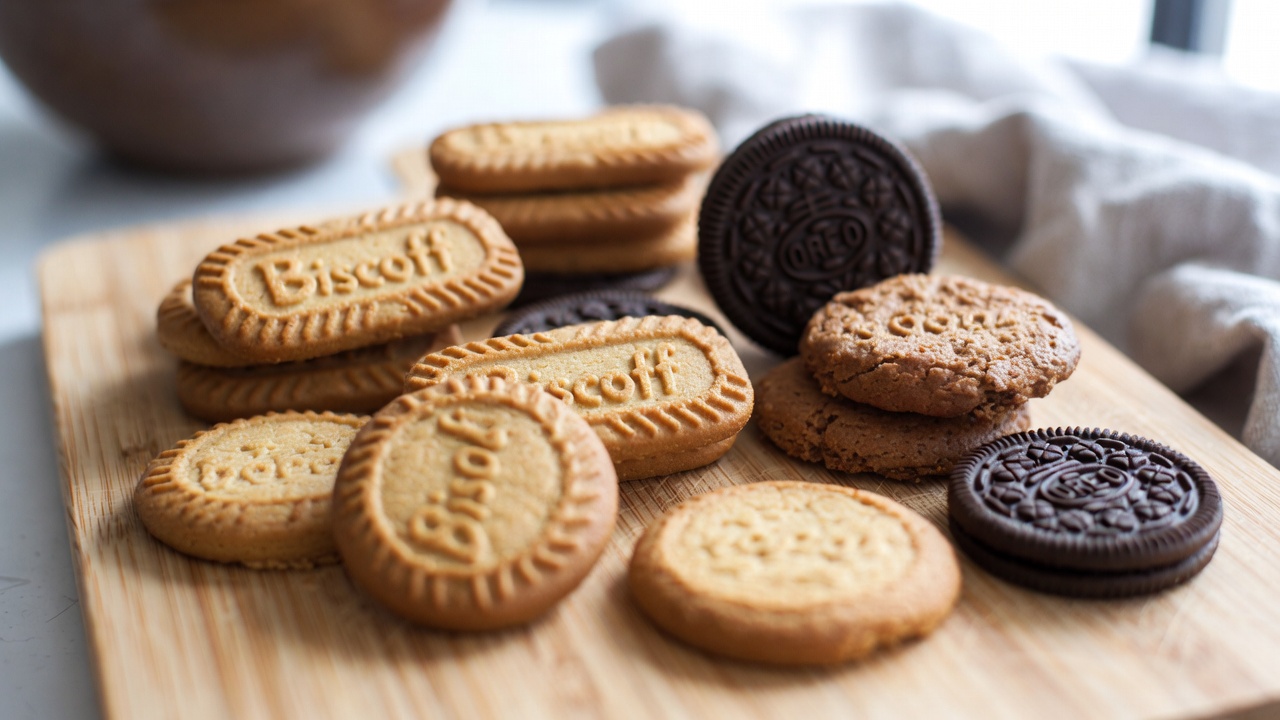
Instead of constantly inventing new brands from scratch—a process that carries high failure rates and massive marketing costs—companies are taking their “Hero” flavors and expanding them across the entire grocery store. This is the essence of Cookie as a Service (CaaS). When you see a Biscoff-flavored protein flapjack or an Oreo-branded ice cream cone, you are witnessing a company “updating” its core asset to reach a new audience without the risk of a new brand launch.
For a beginner investor, this is a vital distinction. You aren’t just betting on a biscuit; you are betting on the intellectual property (IP) of a flavor that consumers already trust.
Lotus Bakeries: The Global “Biscoff” Rollout
Lotus Bakeries ($LOTB) is the gold standard for this model. For years, Biscoff was a niche Belgian cookie served on airplanes. Today, it is a global phenomenon. In their 2025 annual results, the company reported a 10% increase in revenue, reaching €1.355 billion.
What makes Lotus a “Compound King” is their disciplined focus. They have three strategic pillars, but the “Biscoff” pillar accounts for over half of their total revenue. Their strategy for 2026 is built on two specific moves:
- Manufacturing Scalability: To feed demand in Asia, Lotus is opening a massive new factory in Thailand (Chonburi), which is expected to be fully operational by mid-2026. This allows them to produce “Hero” products closer to the consumer, drastically reducing shipping costs and currency risks.
- Strategic Licensing: Rather than trying to master the complex frozen food supply chain themselves, Lotus has partnered with Froneri (a global ice cream giant) to launch Biscoff ice cream worldwide in 2026. They provide the “flavor software,” and the partner provides the “distribution hardware.”
Mondelez: Protecting the $2 Billion Oreo Empire
If Lotus is the rising star, Mondelez International ($MDLZ) is the established titan. Their crown jewel, Oreo, generates over $2 billion in net revenue in the U.S. alone.
At the 2026 CAGNY Conference, Mondelez leadership outlined a clear path: they want their core categories—biscuits, chocolate, and baked snacks—to move from 80% of their total revenue to 90%.
They are doing this by “plugging” their brands into “adjacent” categories. For example:
- Cakes and Pastries: Mondelez is rapidly scaling its presence in the $100 billion global cake market, using Oreo and Cadbury branding to instantly gain market share.
- The India Expansion: Through a massive partnership, Mondelez is now helping Lotus Bakeries distribute Biscoff in India, leveraging the same distribution network that made Oreo a household name there.
The Risks: Inflation and the “Sugar Tax” Reality
No investment is without risk, and the bakery sector faces unique challenges in 2026. For a beginner, it is crucial to look past the “sweet” earnings reports and see the underlying costs.
- Commodity Volatility: The “Cocoa Crisis” of 2024 and 2025 saw prices skyrocket to over $12,000 per ton. While cocoa prices have finally begun to cool in early 2026, trading between $3,700 and $4,000, companies are still working through expensive “locked-in” contracts.
- Valuation Concerns: Because companies like $LOTB are so consistent, they often trade at high valuations. Lotus currently trades at a Price-to-Earnings (P/E) ratio significantly higher than the market average. This means investors are paying a high “entry fee” for the safety of these earnings.
- Health Regulations: Governments globally are increasing pressure on high-sugar snacks. Investors must watch how these companies diversify into “Functional Foods.” Lotus, for instance, has already built a “Natural Foods” division (brands like BEAR and nākd) which grew by 16% in 2025, acting as a hedge against future sugar regulations.
Why It Matters for Your Portfolio
The “Cookie as a Service” model provides a level of revenue predictability that is rare in the stock market. Unlike a tech company that might be disrupted by a new app, the “Oreo” or “Biscoff” flavor has a decades-long moat. People don’t suddenly “delete” their favorite childhood cookie.
For those building a long-term portfolio, these “Compound Kings” offer a blend of:
- Defensive Stability: People buy snacks even in a recession (the “Lipstick Effect”).
- Growth Potential: International expansion in India and China is just beginning for brands like Biscoff.
When a company can treat its flavor like a platform, it stops being a bakery and starts being an IP powerhouse.


