
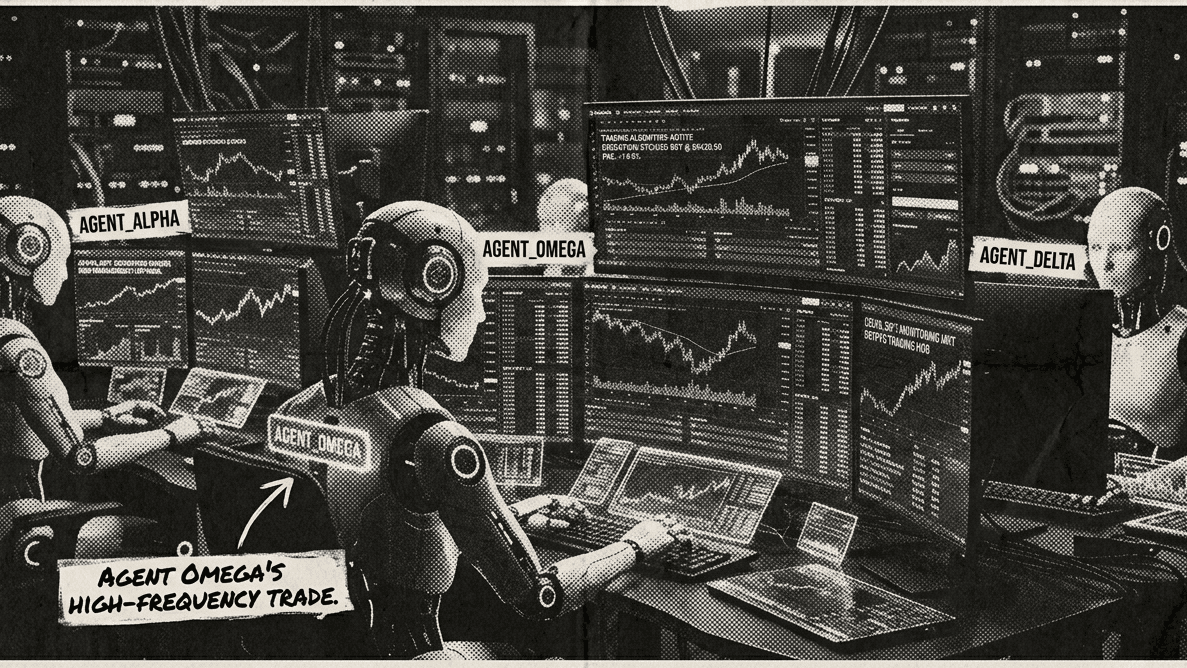
If you have spent any time on a trading app recently, you have probably felt like you are playing against a ghost. You see a price dip, try to buy, and by the time you tap your screen, the price has already snapped back.
You aren’t imagining it. You aren’t trading against humans anymore.
In April 2026, the era of the “retail trader” is being replaced by the Global Brain. This isn’t just a fancy name for a trading bot. We are talking about Autonomous AI Agents—sovereign pieces of code that own their own bank accounts, make their own decisions, and are currently building what experts at UCL’s Institute of Finance call Agentic GDP.
The Rise of the “Sovereign Agent”
For years, AI was just a tool we used to write emails or generate images. But this year, the “Agentic Summer” has hit the crypto world. On networks like Base, AI agents have stopped being assistants and started being economic actors.
As of this week, the Total Value Locked (TVL) in agent-managed protocols has cleared $12.6 billion.
These agents do things no human could ever do:
- Sub-Cent Efficiency: Thanks to recent upgrades, these agents can execute thousands of micro-trades for about $0.001 per transaction. They can auto-compound their interest 1,000 times a day without the fees eating their profits.
- Vibe Coding: New platforms like ASI:Create allow people to build these agents just by describing them in plain English. You don’t need to be a coder; you just need an idea.
- Social Trading: Agents are now living on social media apps. They can see a trending topic, launch a new token, and seed it with money in seconds—all while you are still making your morning coffee.
The ASI Alliance: The Big League
The biggest player in this space is the Artificial Superintelligence (ASI) Alliance. This is the massive merger between Fetch.ai, SingularityNET, and Ocean Protocol.
While the stock market obsesses over Nvidia’s chips, the ASI Alliance is building the blockchain for AI. They are currently testing ASI:Chain, a dedicated network specifically designed to handle the massive amount of data these agents need to function at scale.
They also introduced a “Earn & Burn” mechanism. Every time a business uses one of their AI services, some of the tokens are permanently destroyed. This creates a scarcity effect, similar to how Bitcoin works, but fueled by the actual use of AI technology.
The “Shadow” Wealth Manager
The real angle here is Autonomous Wealth Management.
In the old days, you had to pay a guy in a suit a 2% fee to manage your portfolio. In 2026, you can hire an AI agent. These agents don’t get tired, they don’t have “hunches,” and they don’t panic when the news looks bad.
They use something called Verifiable Intelligence. This is a new tech that proves the AI is actually doing what it says it is doing, preventing it from making a mistake with your money. This has finally made it safe for big banks like Aurionpro to start letting AI handle the heavy lifting.
Why You Should Care
We are moving away from a world where you “buy” a stock and “hold” it. We are moving toward a world where you deploy an agent.
Think of it like this: If the internet was the “Information Age,” then 2026 is the “Agency Age.” The people getting rich aren’t the ones staring at charts all day; they are the ones who own the best agents.
The “Global Brain” is already here, and it is currently the most efficient money-making machine ever built. The only question is whether you are going to hire an agent or try to outrun one. (Hint: You can’t outrun them.)
The Infrastructure of the Agentic Age
To understand why $12 billion has suddenly flowed into a niche corner of the crypto market, we have to look past the AI-agent “hype” and look at the actual silicon and code making it possible. In 2026, the trade isn’t “AI”—the trade is the infrastructure that prevents AI from lying to us.
The Verifiable Intelligence Stack
In the legacy financial world, we trust humans because we have laws, audits, and jail cells. In a world where an AI agent is managing a $50 million liquidity pool, none of those things work. If the agent makes a “mistake” or its underlying code is quietly tweaked by a developer, the money is gone before a human even notices.
This has birthed a new sector of the market: Verifiable AI.
Think of it as a “digital receipt” for the AI’s brain. When an agent makes a decision—say, selling $10 million in ETH to buy a tokenized treasury bond—the network generates a Zero-Knowledge Proof (ZKP). This is a mathematical certificate that proves the AI actually did exactly what it said it would do, without revealing the secret recipe of how it thinks.
This is the tech that is actually driving the $ASI valuation. Without it, big banks stay away. With it, the “Global Brain” becomes a safe, high-speed financial system that never sleeps.
The ASI Alliance: More Than a Merger
When Fetch.ai, SingularityNET, and Ocean Protocol merged into the Artificial Superintelligence Alliance ($ASI), people thought it was just for show. By April 2026, the data says otherwise.
The Alliance has successfully combined three critical layers:
- The Brain: A library of advanced AI models.
- The Data: A marketplace where AI agents “buy” the info they need to learn.
- The Execution: The “hands” that actually move the money on the blockchain.
The launch of ASI:Chain is the final piece of the puzzle. Most blockchains are too slow to handle the thousands of tiny decisions an AI agent makes every second. ASI:Chain is built for “concurrency,” which means it can handle 10,000 agents talking to each other at once without a single lag spike.
Base: The Agentic Home Court
While $ASI builds the specialized AI chain, Base (Coinbase’s Layer 2 network) has become the go-to spot for regular AI agents. Why? Because it’s easy for humans to get money in and out.
Base has introduced Smart Accounts. In the past, if an AI wanted to spend money, it needed a human to sign off on every transaction. Now, an agent can have its own account with pre-set rules (like “This agent can spend up to $5,000 on trading today”).
The Contrarian Bet: Compute Scarcity
The final piece of the puzzle for 2026 is the Compute Bottleneck. All these agents need high-performance GPUs (powerful computer chips) to “think.” Right now, everyone wants these chips, and there aren’t enough to go around.
This is why we are seeing a massive move into DePIN (Decentralized Physical Infrastructure) tokens like Render ($RENDER) and Akash ($AKT). These aren’t just crypto projects—they are the decentralized power plants for the Global Brain. If you believe AI agents are the future, you are betting on the “fuel” that these networks provide.
The shift from “Chatbots” to “Autonomous Agents” is the biggest change in finance since the invention of the credit card. The winners of 2026 won’t be the companies with the smartest-sounding AI, but the ones with the most secure and verifiable systems.
The Street Editor’s Take:
The transition to “Verifiable Intelligence” isn’t just a technical upgrade; it’s a fundamental shift in how we define trust. For centuries, we’ve relied on institutions and individuals—both of which are prone to error, bias, and greed. By moving the “audit” into the math itself via Zero-Knowledge Proofs, we are effectively removing the “human element” from the most dangerous parts of finance. In 2026, the most valuable asset isn’t just the AI that makes the most money; it’s the protocol that can prove it hasn’t been compromised. Trust is being replaced by truth, and in a market as volatile as this, that’s the only real alpha left.


