What Is Global X Uranium ETF?
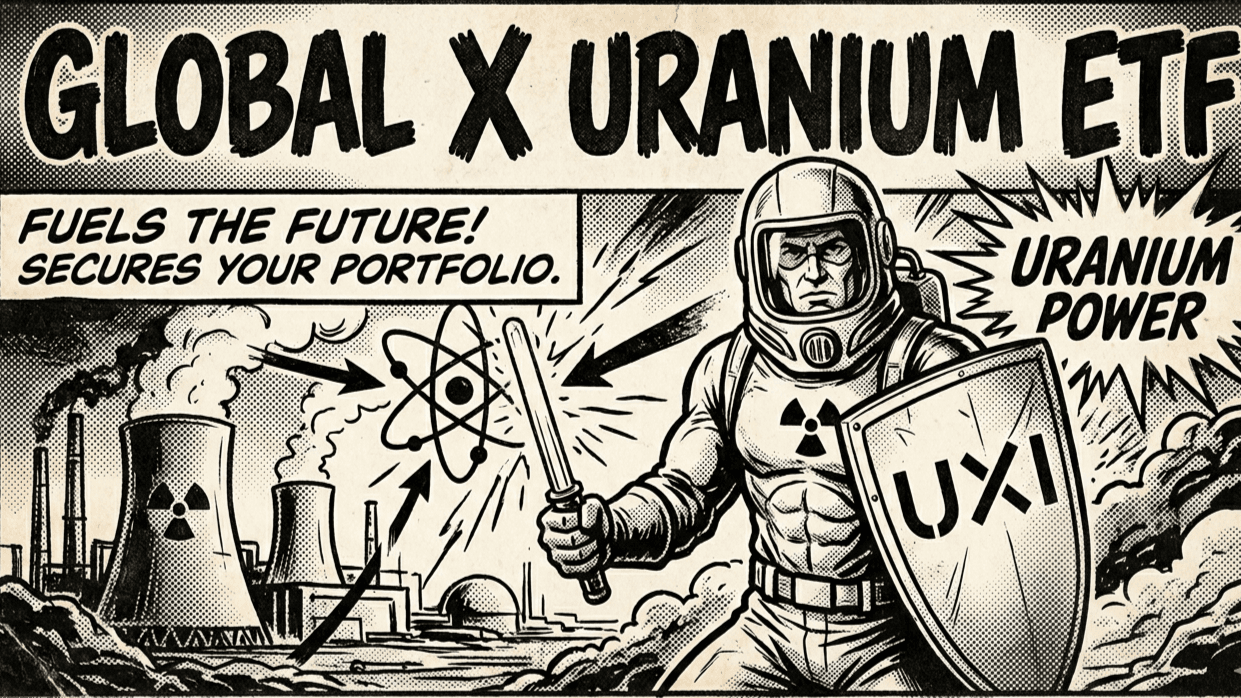
The Global X Uranium ETF ($URA) is a basket of companies that together form the backbone of the nuclear power industry. It is essentially a bet on the fuel that powers roughly 20% of the United States’ electricity and a growing share of the global energy mix. Instead of trying to pick a single winning mining company, $URA allows investors to own the entire supply chain, from the companies digging ore out of the ground to the engineers designing next-generation reactors.
Think of $URA as a “modular energy” fund. While most people think of uranium as just a metal, the ETF treats it as a technology sector. It holds massive Canadian miners like Cameco, physical uranium through the Sprott Physical Uranium Trust, and even specialized construction firms like Daewoo Engineering that build the actual power plants. If the world decides it needs more carbon-free, “always-on” electricity to fuel everything from AI data centers to electric vehicle grids, the companies inside $URA are the ones that must deliver it.
How Does It Make Money?
As an Exchange Traded Fund (ETF), $URA doesn’t manufacture products or sell services. Instead, it makes money for its shareholders by tracking the performance of the Solactive Global Uranium & Nuclear Components Total Return Index. When the stock prices of the companies in that index go up, the Net Asset Value (NAV) of $URA rises accordingly.
The underlying “engine” of value here is the supply and demand of uranium concentrate ($U_3O_8$). Unlike oil, which can be pumped faster when prices rise, uranium mines take 10 to 15 years to bring online. This creates a “sticky” supply. On the demand side, nuclear reactors are long-term assets; once a plant is built, it must buy fuel regardless of the price to keep the lights on. The companies in $URA capture this value in three ways:
- Extraction: Miners sell uranium at market or contract prices.
- Asset Appreciation: Holding physical uranium ($U.UN) which gains value as spot prices rise.
- Services: Engineering and construction firms earn revenue from the “Nuclear Renaissance” of building new Small Modular Reactors (SMRs).
The Numbers That Matter
To understand $URA, you have to look past the ticker and into the prospectus and the broader commodity market.
- Spot Price of Uranium: As of early 2026, uranium is trading near $100 per pound. For most miners, the “all-in sustaining cost” to get uranium out of the ground is significantly lower, meaning current prices represent massive profit margins.
- Total Assets (AUM): $URA manages approximately $7.5 billion. This is important because liquidity allows large institutional investors to enter and exit positions without wildly swinging the price.
- Expense Ratio: The fund charges 0.69%. This is the fee you pay Global X to manage the basket. For a specialized commodity fund, this is standard, though higher than a broad S&P 500 fund.
- Concentration: The top holding, Cameco ($CCJ), often accounts for over 20% of the fund. This means the ETF is heavily influenced by the success or failure of a single Canadian giant.
Why Bulls Love It
The bull case for $URA is built on the “Clean Baseload” thesis. Wind and solar are great, but they are intermittent—they don’t work when the sun is down or the wind is still. As the world digitizes, especially with the massive power requirements of 2026-era Artificial Intelligence, the grid needs steady, massive amounts of carbon-free power. Nuclear is the only existing technology that fits that bill at scale.
Bulls argue we are currently in a “structural deficit.” For over a decade following the Fukushima accident in 2011, uranium prices were so low that nobody built new mines. Now, demand is surging just as old mines are depleting. This creates a “supply crunch” that could keep prices elevated for years. Furthermore, the emergence of Small Modular Reactors (SMRs) from companies like Oklo and NuScale (both $URA holdings) suggests a future where nuclear isn’t just for massive government projects, but for private data centers and industrial parks.
Why Bears Aren’t Convinced
The bear case is founded on two pillars: “Geopolitics” and “Volatility.” A huge portion of the world’s uranium comes from Kazakhstan, a region with significant Russian influence and occasional political instability. Any disruption in Kazakh exports—or a shift in Western sanctions—could send the sector into a tailspin or create a “de-globalized” market where $URA’s global holdings struggle to coordinate.
Technically, bears point to the history of “false starts” in nuclear. Public opinion is fickle; a single high-profile safety incident anywhere in the world could lead to another decade of decommissioning and “not in my backyard” (NIMBY) protests. Additionally, $URA is a high-beta asset. It doesn’t just go down when the market goes down; it tends to crash. If the global economy enters a recession and industrial power demand drops, the speculative premium currently baked into uranium miners could evaporate instantly.
Who Is This For?
$URA is not for the “set it and forget it” retiree. It is a thematic satellite position.
This is for an investor who already has a core portfolio of diversified stocks and is looking for a “kicker” that isn’t correlated to the software or retail sectors. It requires a 5-to-10-year time horizon because the nuclear cycle moves in decades, not quarters. If you can handle seeing your position drop 20% in a month without panicking, and you believe that the path to “Net Zero” must go through a reactor, this ticker fits.
What to Watch
- Kazatomprom Production Guidance: As the world’s largest producer, any news from Kazakhstan about production cuts or “force majeure” events will move $URA more than any other signal.
- The “Big Tech” Nuclear Pivot: Watch for direct power-purchase agreements (PPAs) between tech giants (like Microsoft or Google) and nuclear providers. If Amazon buys a nuclear plant to power an AWS cluster, the “AI-to-Uranium” link becomes a proven reality.
- Enrichment Legislation: Most uranium must be “enriched” before use. Watch for U.S. and EU legislation regarding the ban of Russian enriched uranium. If the West successfully builds its own enrichment capacity (look at $LEU / Centrus Energy), the supply chain becomes much “safer” for investors.
The Scorecard
Business Quality: ★★★★☆
Valuation: ★★★☆☆
Risk Level: ★★★★★ (1 = low risk, 5 = high risk)
Suitable For: Long-term thematic speculators
Time Horizon: 5–10 years
Opportunity Right Now: ★★★★☆
The Street Editor’s Take:
I think the market is finally realizing that you can’t run a 21st-century AI economy on 19th-century “hope-based” energy. $URA is the cleanest way to play the reality that “Green” and “Reliable” only meet at Nuclear. My read is that while the easy money from the initial price recovery has been made, the structural shift is just beginning. The market often treats uranium like a dirty commodity, but in 2026, it’s effectively a “Power Tech” play. I’m less worried about the price of the metal and more focused on the fact that big tech is now incentivized to keep these miners profitable to ensure their data centers stay online. The volatility is a feature, not a bug — if you can’t stomach the swings, you don’t deserve the cycle.
Not financial advice. Always do your own research before making investment decisions.