
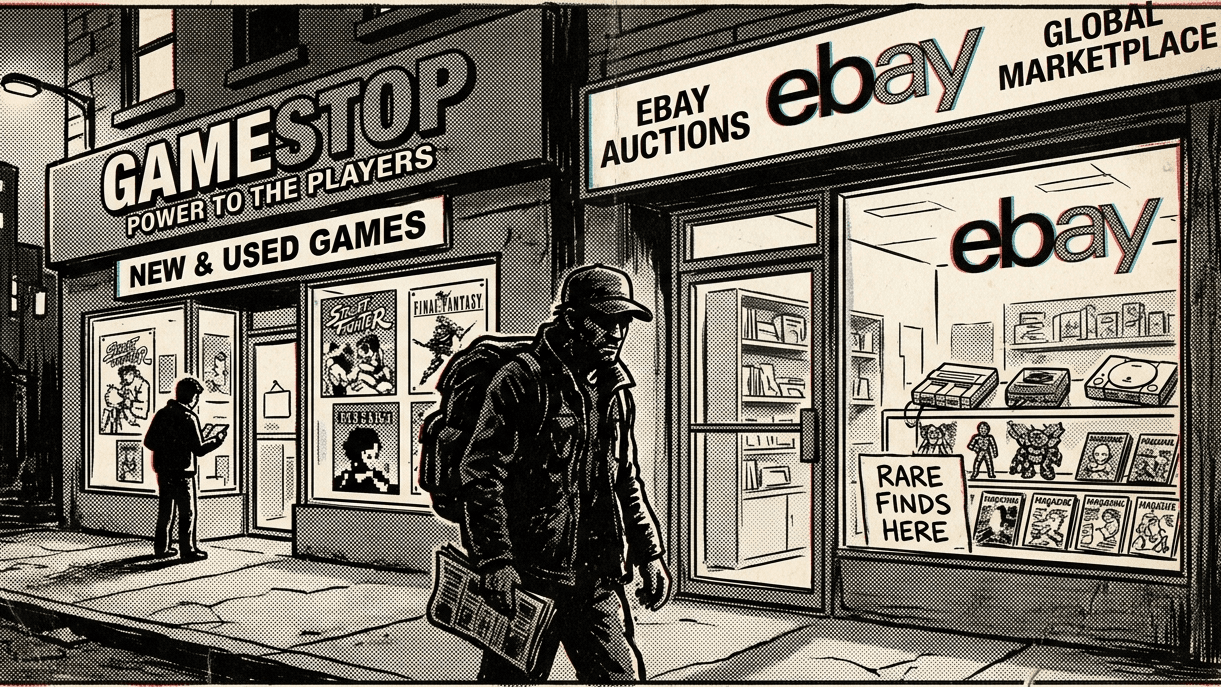
Ryan Cohen once promised investors he would make an acquisition that would be either “genius or totally, totally foolish.” On Sunday evening, the world found out what he had in mind.
According to GameStop’s own 8-K filed with the SEC on May 3, 2026, the company submitted a non-binding proposal to acquire 100% of eBay at $125.00 per share — a deal valuing the e-commerce marketplace at approximately $55.5 billion. The offer is structured as 50% cash and 50% GameStop common stock. GameStop has also secured a non-binding “highly confident letter” from TD Bank for $20 billion in debt financing to support the transaction, per the same filing.
What makes the move genuinely jaw-dropping is the context. GameStop’s own market cap sat at roughly $11 billion before the news broke. It is attempting to buy a company four times its size. To fund the cash portion alone, it would need to deploy essentially its entire $9.4 billion cash pile — and then issue a staggering amount of new stock on top to cover the equity half. That dilution is almost certainly why $GME slid 8.5% on Monday while $EBAY rose just 5%, landing around $109 — well below the $125 offer price. When the stock of the acquirer falls and the target doesn’t reach the offer price, the market is saying one thing: we don’t think this closes.
The Strategy Behind the Chaos
Cohen isn’t being random here, even if the move looks like one. According to GameStop’s investor presentation filed alongside the proposal, the combined company would target $2 billion in annual cost reductions within twelve months of closing — cutting eBay’s marketing spend roughly in half, trimming product development, and slashing general and administrative costs. GameStop projects that those cuts could take eBay’s diluted GAAP EPS from $4.26 to $7.79 in year one.
The physical store angle is the most creative part. Cohen’s pitch is that GameStop’s approximately 1,600 US stores become a national network for authentication, intake, fulfilment and live commerce — effectively turning every GameStop location into a drop-off and verification point for eBay’s collectibles and high-value goods. Cohen told the Wall Street Journal he believes the combined entity “could be a legit competitor to Amazon.”
It’s worth noting that Cohen quietly built a 5% stake in $EBAY starting February 4, 2026, using derivatives alongside common stock — a classic activist toehold. The $125 offer represents a 46% premium to eBay’s closing price on that day. Cohen’s board approved the proposal unanimously, he confirmed on CNBC’s Squawk Box on Monday — a combative interview in which he repeatedly deflected questions about financing by directing viewers to the company’s website.
eBay’s Response
eBay confirmed receipt of the proposal in an official press release published May 4. The statement is carefully worded: “eBay had no discussions with or outreach from GameStop prior to receiving the proposal.” The board said it would review the proposal with financial and legal advisors, and advised shareholders to take no action. It notably flagged that its review would focus on “the value of the GameStop stock consideration and the ability of GameStop to deliver a binding, actionable proposal” — a polite way of questioning whether $GME can actually fund a $55.5 billion deal.
What to Watch
Two things matter most from here. First, whether Cohen follows through with a tender offer directly to eBay shareholders if the board rejects him — he told the Wall Street Journal he is prepared to do exactly that, which would make this the largest hostile takeover attempt in US retail history. Second, watch for any Schedule 13D amendments from other activist investors circling $EBAY now that it’s in play. eBay’s next scheduled investor communication is the place management will need to make a convincing case that its standalone strategy outperforms what Cohen is offering.
The Street Editor’s Take:
My read is that the financing gap is the story, not the strategy. Cohen’s operational thesis — cut eBay’s bloated cost structure, use the stores for authentication, compete with Amazon — is actually coherent. It’s not crazy. What is hard to explain is how a company worth $11 billion credibly acquires one worth $55 billion. The TD Bank letter covers $20 billion. The cash pile covers $9.4 billion. That still leaves a gap that only aggressive stock issuance can fill — and issuing that much new $GME stock at current prices would obliterate existing shareholders. Until Cohen shows a binding financing plan that doesn’t require $GME to print itself into irrelevance, I’d treat $EBAY as a speculation on a deal that probably doesn’t happen and $GME as a stock to watch from the sidelines.


